LED Screen vs Billboard: Which Advertising Display Is Best?
Introduction
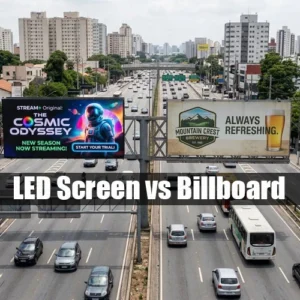
Outdoor advertising remains one of the most reliable methods for building brand awareness, driving foot traffic, and securing high-volume audience impressions. However, the out-of-Home (OOH) media landscape has shifted dramatically over the past decade. Business owners, media buyers, and marketing executives face a critical decision when investing in large-format displays: Digital LED Screens (DOOH) or traditional static billboards.
While traditional printed billboards have dominated highways and city centers for decades, digital LED display panels offer dynamic content capabilities, remote updates, and superior luminescence. Choosing the right medium requires a thorough understanding of up-front capital expenditures, ongoing operational costs, viewing distances, local zoning regulations, and campaign flexibilities.
Table of Contents
Defining the Technologies
To make an informed decision, it is essential to understand the structural and engineering differences between digital LED systems and traditional printed advertising structures.
What is a Digital LED Screen?
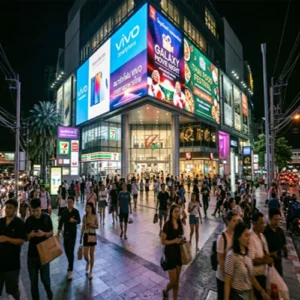
A digital LED screen is often referred to as a Digital Out-of-Home (DOOH) billboard or display wall and consists of module LED panels tile-mounted together to form a seamless display surface. Each panel houses hundreds or thousands of Surface-Mounted Device (SMD) or Chip-on-Board (COB) light-emitting diodes. These diodes generate their own light, producing vibrant full-color images, high-definition videos, and dynamic motion graphics.
Modern outdoor LED screens feature advanced brightness settings (typically between 5,000 and 10,000 nits) to maintain full daylight readability under direct sunlight. They are governed by an internal media player and an internet-connected Content Management System (CMS), allowing operators to upload, schedule, and change graphics remotely within seconds.
What is a Traditional Billboard?
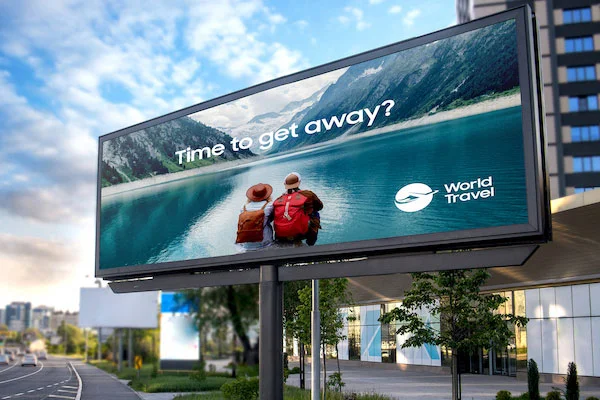
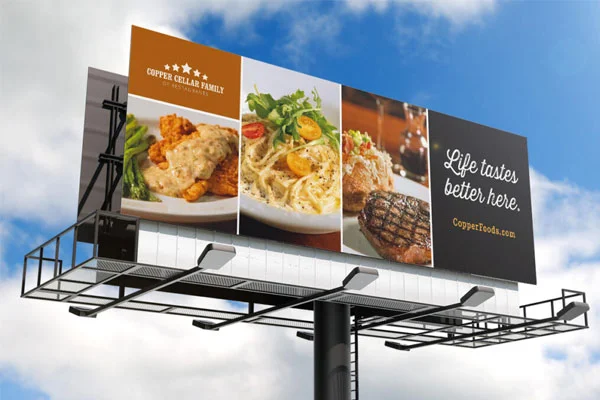
A traditional billboard is a static physical structure, typically steel-framed, that displays large-format printed graphics. The graphic substrate is usually printed on heavy-duty, weather-resistant vinyl or flexible PVC fabric, stretched across the billboard frame and secured with tension ratchets or hooks.
Unlike LED displays, traditional billboards do not generate light internally. To maintain visibility at night, static billboards rely on external lighting fixtures, usually on top- or bottom-mounted metal halide or exterior LED floodlights aimed directly at the printed vinyl face.
Core Comparison Metrics
When evaluating outdoor advertising channels, marketers must compare structural capabilities against commercial goals.
| Feature/Metric | Digital LED Display (DOOH) | Traditional Printed Billboard |
| Content Type | Motion video, dynamic visuals, multiple ads in rotation | Static image or text only |
| Luminescence & Visibility | Self-illuminated (5,000 – 10,000 nits) high daylight contrast | External spotlighting required at night |
| Content Update Speed | Instantaneous via cloud-based CMS software | 3 to 7 days (required physical printing & installation) |
| Creative Flexibility | Unlimited design swaps, dayparting, real-time RSS feeds | Single creative execution per print run |
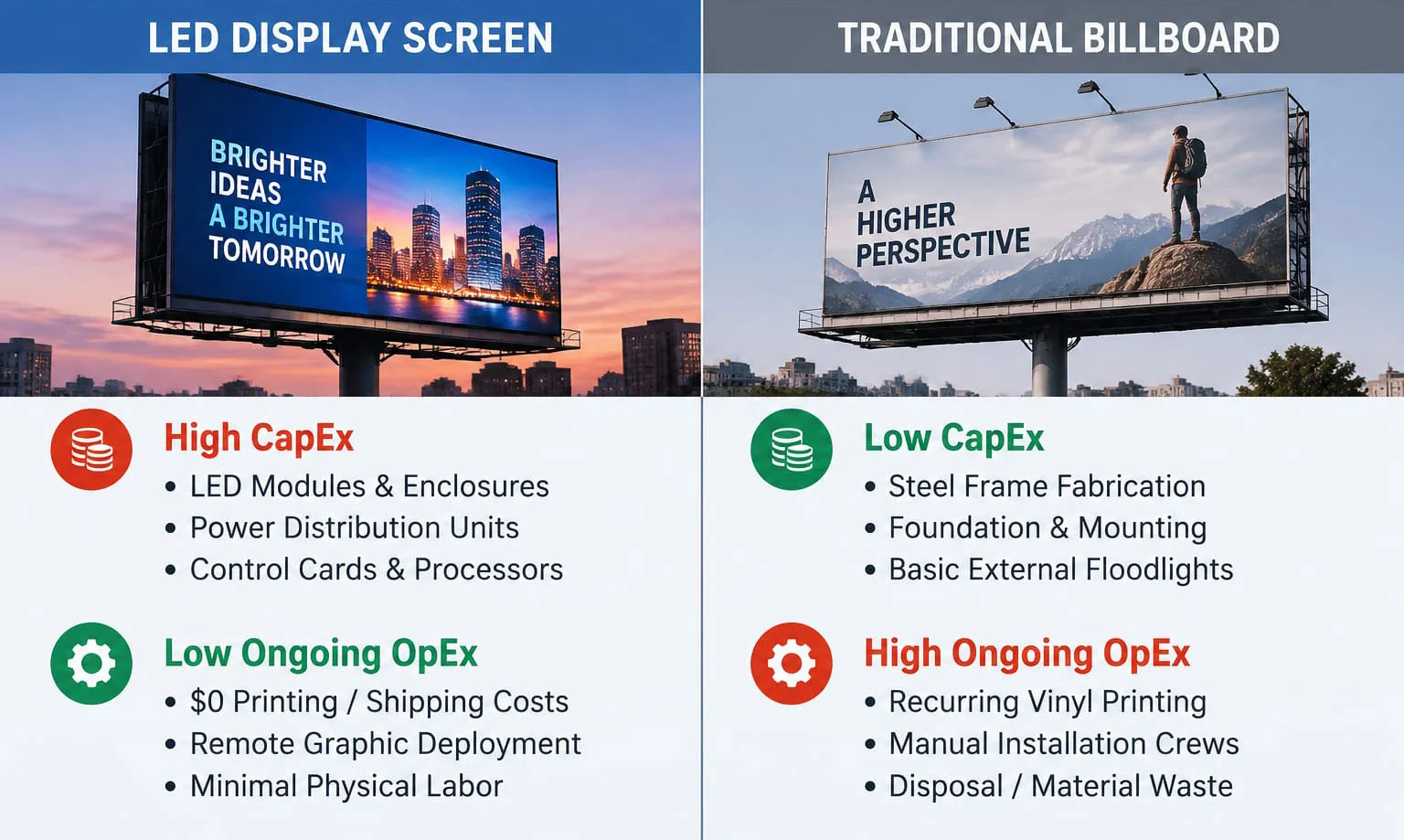
| Initial Upfront Investment | High (hardware, structural engineering, power setup) | Low to moderate (standard steel fabrication & vinyl) |
| Ongoing Production Cost | Low (digital artwork exports require zero printing | Recurring vinyl printing, shipping, and installer crew costs |
| Ad Space Ownership | Shared slots (e.g., 6-8 slots per screen) or 100% dedicated | 100% exclusive visual dominace |
| Lifespan/Durability | ~100,000 hours (~8-10 years) for LED modules | Vinyl requires replacement every 1-3 months. |
Financial Analysis: Costs, Maintenance, and ROI
Understanding the financial breakdown of LED screens versus traditional billboards requires separating Initial Capital Expenditure from Long-Term Operating Expenditure.
Visual Impact and Audience Engagement
The ultimate goal of any advertising medium is to capture viewer attention. How do these two formats stack up in real-world environments?
Dynamic Visuals vs. Static Messaging
Human eyes are naturally wired to detect motion. Digital LED displays leverage high-refresh-rate video (> 3840 Hz), vibrant color gamut, and full-motion animation to seize driver and pedestrian attention far more effectively than static print.
A static billboard delivers a single, unchanging message. If a commuter passes the same traditional billboard every day on their route to work, visual fatigue sets in within days, a phenomenon known as advertising blindness. Conversely, an LED display can rotate through different creative assets, display animation sequence variations, or feature dynamic countdown timers, keeping the visual presentation fresh.
Daylight Readability and Weather Factors
- Direct Sunlight: High-grade outdoor LED screens utilize ultra-bright, narrow-angle LEDs capable of pushing past ambient daylight reflections. Furthermore, black-mask LED cabinetry enhances visual contrast ratios, ensuring dark tones remain rich even at noon.
- Weather Degradation: Printed vinyl billboards suffer from UV fading, tearing during severe windstorms, and sagging over time if tensioning slackens. High-quality IP65-rated LED cabinets protect internal electronics against rain, snow, dust, and humidity, keeping image quality constant across years of service.
Flexibility and Campaign Control
Campaign agility is where digital screens show a decisive advantage. Modern marketing strategies rely on real-time data, quick adaptation, and content-specific messaging.
Real-Time Updates & Dayparting
With digital billboards, advertisers are no longer locked into static messaging for weeks at a time. Digital platforms enable dayparting: scheduling specific ads to air at strategic times or day:
- Morning commute (7:00 AM – 9:00 AM): A coffee chain displays breakfast combo promotions and hot espresso offers.
- Midday (12:00 PM – 1:30 PM): The creative switches automatically to a local quick-service lunch deal.
- Evening Commute: (5:00 PM – 7:00 PM): The screen transitions to food delivery apps, automotive ads, or evening entertainment.
Contextual Triggering
Modern CMS software allows outdoor LED screens to react to live external data feeds:
- Weather-Responsive Ads: An apparel brand displays rain jackets during storms and swimwear during sunny afternoons.
- Live Scores & Inventory: A sports betting platform displays real-time odds, while dealerships update remaining vehicle inventory figures live.
Understanding Spatial Constraints: Pixel Pitch & Distance
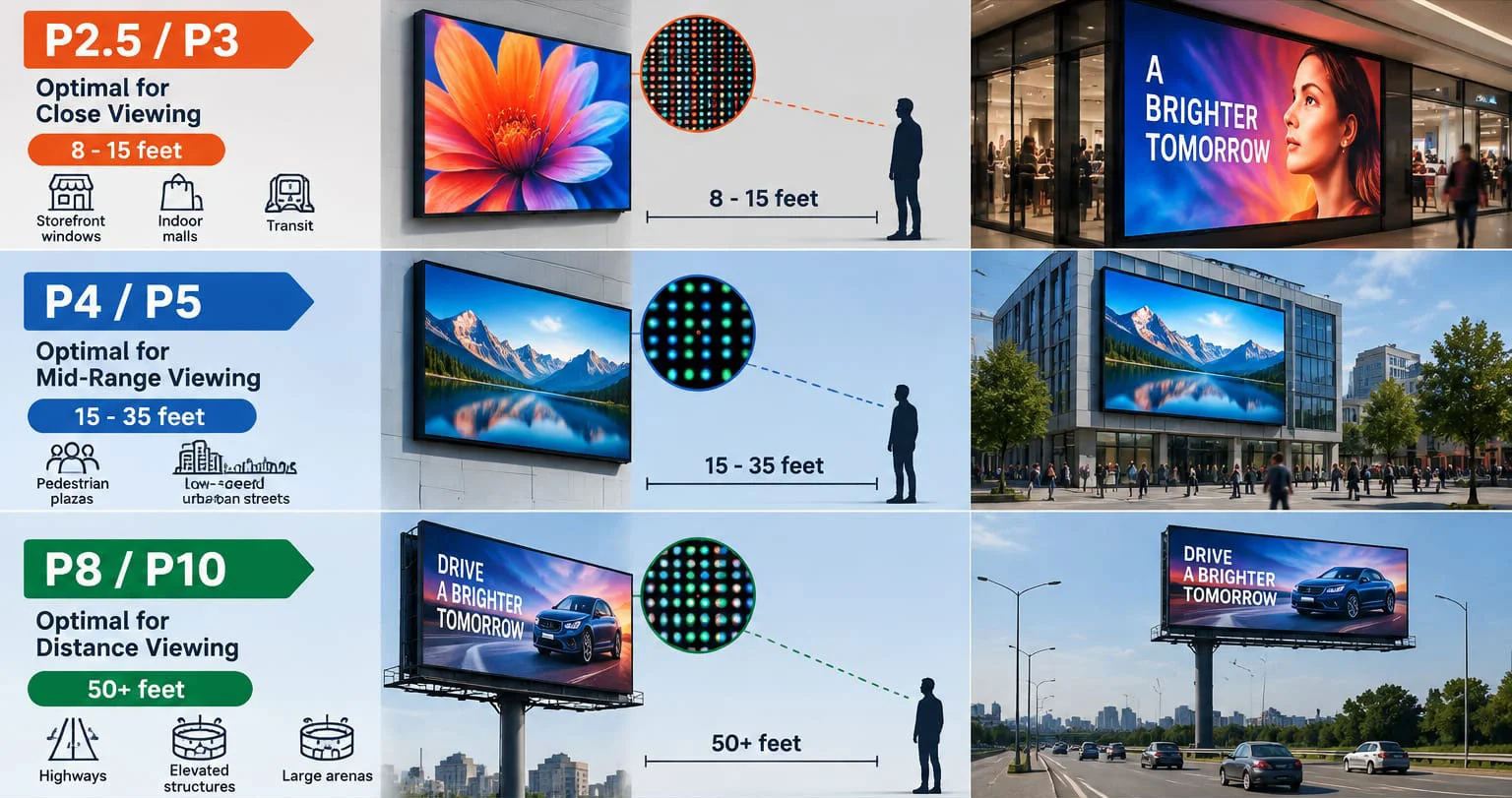
When selecting an LED screen over a traditional billboard, understanding display specs- specifically, pixel pitch. It is critical to achieving clear picture quality without overspending.
Pixel pitch refers to the distance (in millimeters) from the center of one LED to the center of the adjacent LED.
- Smaller Pixel Pitch (e.g., P2.5 to P4): Higher pixel density, higher resolution, and a closer minimum viewing distance. Ideal for pedestrian zones, retail store windows, and street-level installations.
- Larger Pixel Pitch (e.g., P8 to P10+): Lower pixel density, designed for long-distance viewing along highways and elevated structures. Because viewers are 100+ feet away, individual diodes blend seamlessly into a continuous image, significantly reducing display panel costs without sacrificing perceived clarity.
Which Display Should You Choose?
Selecting between an LED screen and a traditional static billboard depends on your campaign strategy, target audience, site location, and budget constraints.
Choose an Outdoor LED Screen if:
- You need multiple campaigns or flexible scheduling: You can run promotions, time-sensitive events, or want to display dynamic messaging based on time or weather.
- You want to maximize revenue per square foot: If you own the billboard location or signage structure, digital display conversion lets you sell 6 to 8 ad slots on a single screen instead of just one static face.
- Maximum visual impact is essential: Your site benefits from high-brightness, vibrant color contrast, video capabilities, and eye-catching movement to stand out in high-density commercial areas.
- Zero production turnaround is required: You need the ability to upload new artwork immediately without waiting for printing, shipping, and manual hanging.
Choose a Traditional Billboard if:
- You require 100% exclusive visual dominance: You want your brand displayed 24 hours a day, 7 days a week, without sharing screen time with rotating advertisers.
- Upfront capital is strictly limited: Your initial infrastructure budget cannot accommodate the initial hardware purchase and power distribution requirements of an LED system.
- Permitting or power restrictions apply: The targeted installation location lacks access to high-capacity electrical utilities, or local municipal sign codes forbid digital displays or illuminated animations.
- Target simple, long-term directional messaging: You need a permanent directional sign where the messaging stays identical for years.
Both advertising formats remain highly effective components of modern out-of-home media strategies. While traditional billboards provide continuous, single-brand dominance at a lower barrier to entry, LED display screens deliver the flexibility, high-brightness visibility, and dynamic capabilities required for modern data-driven marketing campaigns.
Installation, Structural Engineering, and Municipal Permitting
Deploying an outdoor digital display or traditional billboard involves far more than simply purchasing hardware. Large-format signage requires structural design, electrical planning, and strict compliance with local municipal codes.
Structural Engineering and Load Considerations
A primary engineering challenge for outdoor displays is managing structural loads. Digital LED screens and traditional billboards must withstand two primary forces:
- Dead Load: The static weight of the physical display hardware, steel framing, power supplies, and access catwalks. While traditional vinyl billboards are lightweight, standard outdoor LED display cabinets weigh between 25 kg to 45 kg per square meter, requiring heavier support columns and reinforced concrete footings.
- Wind Load: Wind pressure is a critical factor for elevated outdoor structures. Traditional billboards allow some wind bleed through porous vinyl mesh, but solid LED cabinets act as an impermeable wall. Structural engineers calculate local maximum wind speeds to prevent structural deflection or failure.
Power Infrastructure and Thermal management
Unlike static vinyl displays that only require standard 110/220V circuits for exterior lighting, outdoor LED video walls demand substantial electrical capacity.
- Power Drops: Large DOOH screens often require 3-phase commercial electrical lines. Operators must calculate Peak Power Consumption and Average Power Consumption to size circuit breakers, transformers, and cabling correctly.
- Thermal Management: LED components generate heat. Without adequate heat dissipation, diode lifespans decrease rapidly, and color shift occurs. Outdoor cabinets rely on passive aluminum heat sinks, internal forced-air fans, or integrated air conditioning units for installations in extreme desert or tropical environments.
Navigating Permits and Municipal Zoning
Zoning approval is frequently the longest phase of an outdoor signage project. Local municipalities enforce strict sign codes that distinguish clearly between static and digital advertising:
- Luminance and Light Pollution Regulations: Many cities mandate that outdoor digital screens include automated ambient light sensors. These sensors automatically dim screen brightness to 300-500 nits at night to prevent driver glare and light trespass into residential zones.
- Dwell Time and Motion Restrictions: Highway authorities often restrict video motion on roadside screens. They frequently enforce a minimum dwell time and forbid abrupt flashes or continuous full-motion video that could distract drivers.
Content Management and Advertising Revenue Models
Once hardware is installed, operational success hinges on software management and commercial monetization strategies.
Remote Content Management Systems (CMS)
Modern DOOH networks are managed via cloud-based CMS software platforms. Key operational capabilities include:
- Remote Scheduling & Proof of Play: Operators can schedule ad rotations, track playback logs down to the exact second, and generate automated “Proof of Play” reports for paying advertisers.
- Hardware Diagnostics: Advanced CMS platforms monitor power consumption, internal cabinet temperatures, sending/receiving card connectivity, and individual module failures in real time, sending instantly alerts to field technicians before a full outage occurs.
Conclusion
Choosing between a digital LED screen and traditional billboard depends on balancing budget limitations against campaign goals.
- Select a Traditional Billboard if you need a cost-effective, low-maintenance display for long-term directional messaging, have minimal upfront capital, or operate in a zone with strict regulations against digital displays.
- Select a Digital LED Screen if you want to maximize ad slot revenue, run dynamic content-aware campaigns, eliminate recurring printing/installation labor, and deliver high-contrast visual engagement that captures immediate audience attention.
By evaluating pixel pitch requirements, IP rating weatherproofing, site power capacity, and municipal regulations beforehand, you ensure your outdoor advertising investment delivers maximum visibility and long-term return.